
The Truth About Superwash Merino Wool: What the Science Actually Says
If you've spent any time researching merino wool, you've probably encountered the superwash debate. Type "superwash wool" into any fiber forum and you'll find strong opinions: superwash wool is "coated in plastic," it "destroys wool's natural properties," it's "greenwashing disguised as convenience."
We use superwash-treated merino wool at Aiua. Specifically, we use the chlorine-Hercosett process, the most common method for making wool machine-washable. And since this is the number one question we get from customers, we want to address it directly — not with marketing language, but with peer-reviewed science.
Here's our position: the concerns about superwash wool are understandable, but the most common claims don't hold up under scientific scrutiny. Let's walk through them.
What Superwash Actually Is
First, some context on what happens during the chlorine-Hercosett process.
Wool fibers have an outer layer called the cuticle — overlapping scales, similar to the shingles on a roof. These scales are what cause untreated wool to shrink and felt when agitated in water. The fibers interlock and tighten, and the fabric contracts.
The chlorine-Hercosett process works in two steps. First, a mild chlorine treatment partially removes the outer edges of the cuticle scales, smoothing the fiber surface. Then, a very thin coating of Hercosett resin — a polyamide-epichlorohydrin polymer — is applied to the fiber. This coating prevents the remaining scales from interlocking during washing, which is what stops the shrinking.
The word "coating" is what tends to alarm people. It conjures images of wool fibers encased in plastic, like shrink-wrap around a natural material. But the reality is different. The Hercosett layer is extremely thin — measured in fractions of a micron — and it fundamentally changes the surface chemistry of the fiber without creating a meaningful barrier between the wool and the outside world.
The question is: does this process compromise the properties that make merino wool worth choosing in the first place?

Myth 1: "Superwash Wool Is Coated in Plastic That Doesn't Biodegrade"
This is the most common claim, and the one with the strongest scientific rebuttal.
In 2024, researchers at AgResearch Ltd. in New Zealand published a peer-reviewed study in the journal Water, Air, & Soil Pollution titled "Marine Biodegradation Behavior of Wool and Other Textile Fibers." The study compared the biodegradation of six fiber types in a simulated marine environment over 90 days, using the ASTM D6691 standard test method — the same protocol used to evaluate the biodegradability of plastics.
The six fibers tested were untreated wool, chlorine-Hercosett treated (machine-washable) wool, polyester, nylon, polypropylene, and viscose rayon. The fabrics were supplied by The Woolmark Company and were intentionally matched in structure — all single-jersey knits designed for next-to-skin base layers — so the only variable was the fiber itself.
The results were striking.
Machine-washable wool biodegraded 26.9% over 90 days, making it the most biodegradable textile fiber tested — even more than untreated wool, which reached only 8.1%. For comparison, polyester reached 2.5%, nylon 0.3%, and polypropylene 0.7%. Viscose rayon came in at 25.8%, just behind the treated wool.
To put this in perspective: machine-washable wool biodegraded more than three times faster than untreated wool, and more than ten times faster than polyester.
The researchers attributed this counterintuitive result to the chlorine-Hercosett treatment itself. The chlorine step removes wool's natural hydrophobic outer layer (a fatty acid called 18-methyleicosanoic acid), making the fiber surface more accessible to marine microorganisms. The Hercosett resin, being hydrophilic, absorbs water and swells when immersed, eventually detaching from the fiber surface and further exposing the wool to microbial attack.
In other words, the treatment that critics call "plastic coating" actually makes the wool easier for nature to break down — not harder.

Wool is 100% biodegradable.
Myth 2: "The Hercosett Resin Creates Microplastic Pollution"
This is the logical follow-up concern: even if the wool biodegrades, what about the resin itself? Does it break off and become microplastic?
The AgResearch team examined this directly. After the 90-day biodegradation test, they collected the solid residues of the machine-washable wool and analyzed individual fragments under scanning electron microscopy (SEM). They specifically selected fragments that visually resembled microplastics — the kind of debris that would be concerning if it were non-biodegradable resin.
Using energy dispersive X-ray spectroscopy (EDX), they analyzed the elemental composition of these fragments. Every fragment contained sulfur at levels consistent with wool fiber. This is significant because Hercosett resin does not contain sulfur. If the fragments had been pieces of resin, their sulfur content would have been near zero.
The conclusion: the fragments were degraded wool, not Hercosett resin. The researchers found no evidence of non-biodegradable residues from the superwash treatment.
Further supporting this, the researchers analyzed the nitrogen levels in the residual seawater. Machine-washable wool produced disproportionately more nitrogen during biodegradation than untreated wool — about four times as much, despite only three times the biodegradation. Since Hercosett is a polyamide (nitrogen-containing), this excess nitrogen is consistent with the resin itself biodegrading along with the wool fiber.
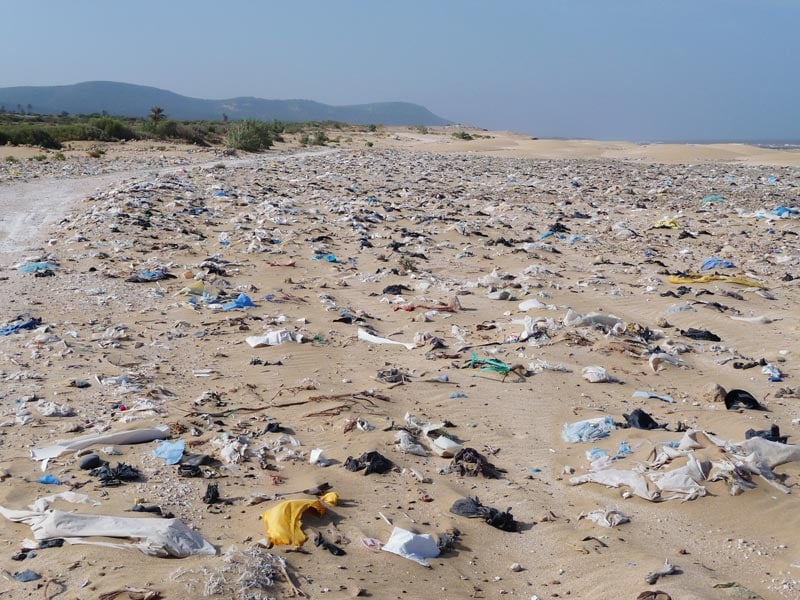
Wool does not contribute to the microplastic textile pollution plaguing our waterways.
Myth 3: "Superwash Destroys Wool's Natural Properties"
This claim is more nuanced, and in some specific ways it's partially true — but the full picture matters.
The chlorine-Hercosett process does modify the fiber surface. It changes the wetting behavior of the wool, making it more hydrophilic. Some purists argue this diminishes wool's natural moisture management.
But here's the distinction that often gets lost: the treatment modifies the surface of the fiber, not the interior structure. Wool's thermoregulation, odor resistance, and moisture-wicking properties come from the complex internal architecture of the cortical cells, the crimp of the fiber, and keratin's inherent biochemistry. The surface treatment affects how water initially interacts with the fiber, but the fundamental performance characteristics of merino wool remain intact.
Our own products bear this out. Our 100% merino wool tees and tanks are machine-washable thanks to the superwash treatment, and they deliver the odor resistance, temperature regulation, and breathability that customers expect from merino. Our clothes maintain the natural properties or merino, and are more practical for everyday use.

Superwash affects the surface of the wool fiber, leaving the core in tact.
What the Science Doesn't Say
We want to be transparent about the limitations of the evidence too.
The Collie et al. (2024) study was conducted in a controlled laboratory setting, not in the open ocean. Real-world marine conditions vary enormously in temperature, microbial populations, and other factors. A 2023 study by Hodgson et al. found that in soil burial conditions, machine-washable wool actually showed initial resistance to decomposition compared to untreated wool — the opposite pattern from the marine study. This makes sense mechanistically: soil environments don't continuously immerse the fiber in water the way the marine test does, so the Hercosett resin doesn't swell and detach as readily. Still, the researchers went on to conclude that the machine-washable wool still hit 95%+ mass loss by the end of the study period; it just took a bit longer.
The takeaway isn't that superwash wool is universally superior to untreated wool in biodegradation. It's that superwash wool still biodegrades — readily, in marine environments especially — and that the Hercosett treatment does not produce microplastic pollution based on the best available evidence.
It's also worth noting that the AgResearch study was funded by Australian Wool Innovation Limited, which has a commercial interest in positive results for wool. The study was peer-reviewed and published in an established journal, and the methodology is transparent and reproducible. But we think you should know who funded it.
Why We Use Chlorine-Hercosett
When we started Aiua, we had dreams of making activewear from non-superwash wool. But after months of research and testing, we concluded that alternatives to superwash wool (plasma, ozone) were cost-prohibitive and simply not as effective at preventing shrinkage and felting.
We chose the chlorine-Hercosett process for a practical reason: it makes 100% merino wool genuinely machine-washable. That matters because one of the biggest barriers to people adopting merino is the perception that it's delicate and high-maintenance. If wool activewear requires hand-washing, most people just won't bother — they'll buy polyester instead.
We want more people to wear natural fabrics. Every polyester shirt sold instead of merino is a shirt that will shed microplastics with every wash for its entire lifespan, and then sit in a landfill for centuries. The calculus, as we see it, is straightforward: a superwash merino shirt that people actually wear and wash regularly is better for the environment than an untreated merino shirt that intimidates people into buying synthetic alternatives. We cannot let perfect be the enemy of good.
We're also OEKO-TEX, RWS (Responsible Wool Standard), and BSCI certified. The superwash treatment our manufacturer uses is conducted under controlled conditions that meet international safety and environmental standards.
We're continuing to stay abreast of the latest research in wool treatments, and if the day comes that an alternative become as effective as superwash, we will incorporate it into our processing methods.
The Bottom Line
The superwash debate is worth having. Healthy skepticism about chemical treatments applied to natural fibers is reasonable and good. But that skepticism should be informed by evidence, not by the assumption that any chemical modification is inherently bad.
Here's what the peer-reviewed science tells us:
Chlorine-Hercosett treated wool biodegrades readily in marine environments — faster, in fact, than untreated wool. The treatment does not produce microplastic residues. The Hercosett resin itself appears to biodegrade alongside the wool fiber. And the fundamental performance properties of merino wool — odor resistance, temperature regulation, breathability — are preserved through the treatment.
Superwash merino is a practical solution that makes the best natural performance fiber accessible for everyday use, without the environmental downsides that critics assume.
If you want to read the research yourself, the full study is open access: Collie, S., Brorens, P., Hassan, M.M. & Fowler, I. (2024). "Marine Biodegradation Behavior of Wool and Other Textile Fibers." Water, Air, & Soil Pollution, 235, 283. Read it here.
Aiua makes 100% merino wool activewear — tank tops, t-shirts, and quarter-zips — for people who care about what their clothes are made of. All of our products are RWS certified and machine-washable. Shop the collection.